CARTIS · Climate Intelligence
Carbon-market answers you can defend.
Climate Intelligence turns standards and methodologies into machine-readable rules, runs them before any AI agent, and keeps a trace of both.
- Rules first
- a deterministic engine runs before any model
- 6
- constrained analysis agents
- Versioned
- every rule, formula and factor
- Graded
- a defensibility index on every answer
Why it exists
A carbon project lives or dies on a methodology document. Before spending money, a developer needs to know whether the activity is eligible, what the baseline will credit, which country rules apply and what the credits might be worth. The answers sit in hundreds of versioned PDFs across the CDM, Article 6.4, Verra, Gold Standard, ICVCM and India's CCTS, and a general-purpose chatbot cannot say which version it relied on.
What CARTIS does
CARTIS turns the methodology corpus into machine-readable rules and answers carbon-market and compliance questions in a way that can be defended. A deterministic rule engine and guardrails run before any AI agent, and every answer records the rule versions and evidence it used. It sits at the centre of MARIS and informs every other product.
At work
See CARTIS do the job
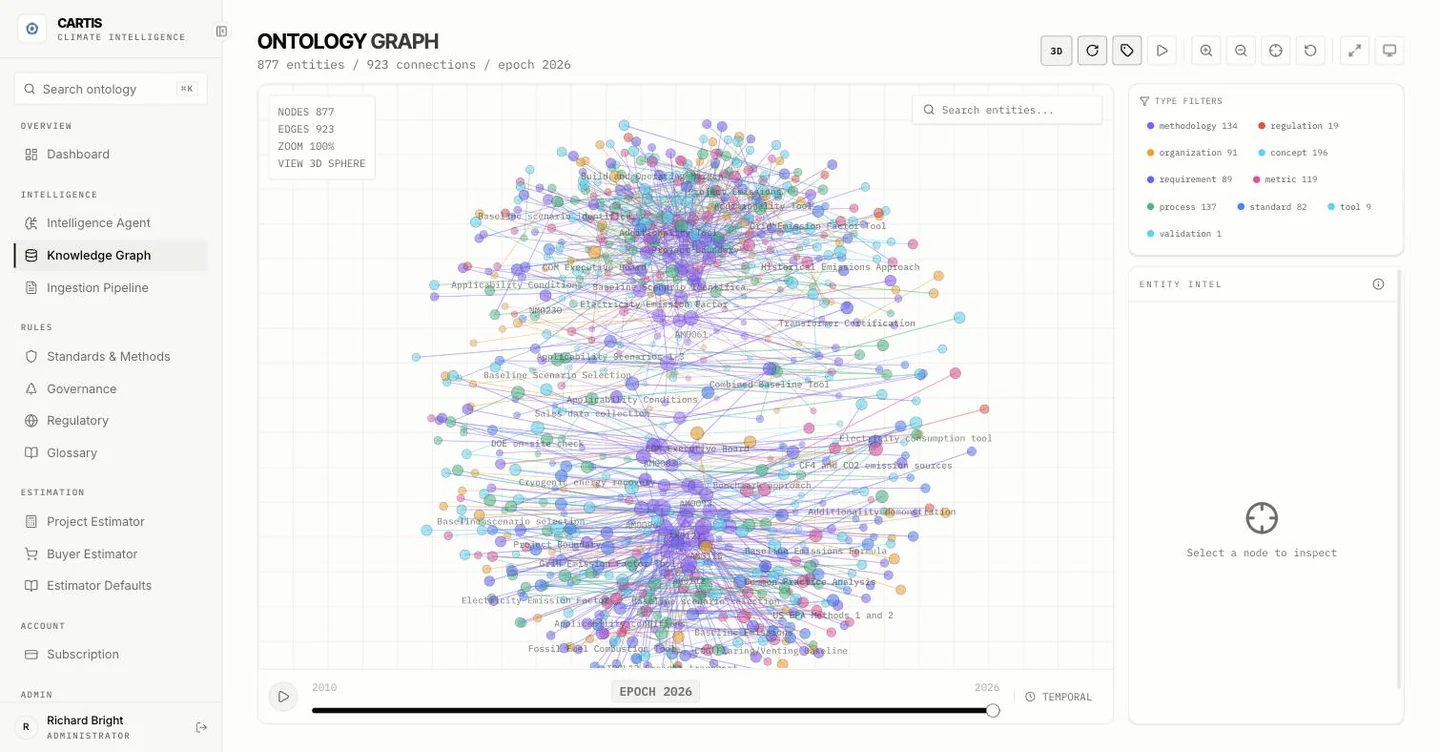
Knowledge graph
The methodology corpus, connected
Standards, methodologies, regulations, requirements and concepts become entities in one graph, so a question about eligibility can follow the links a consultant would follow by hand.
- Entities and relationships, queryable
- A governed corpus with reliability scores
- Every document linked to its standard
Agents
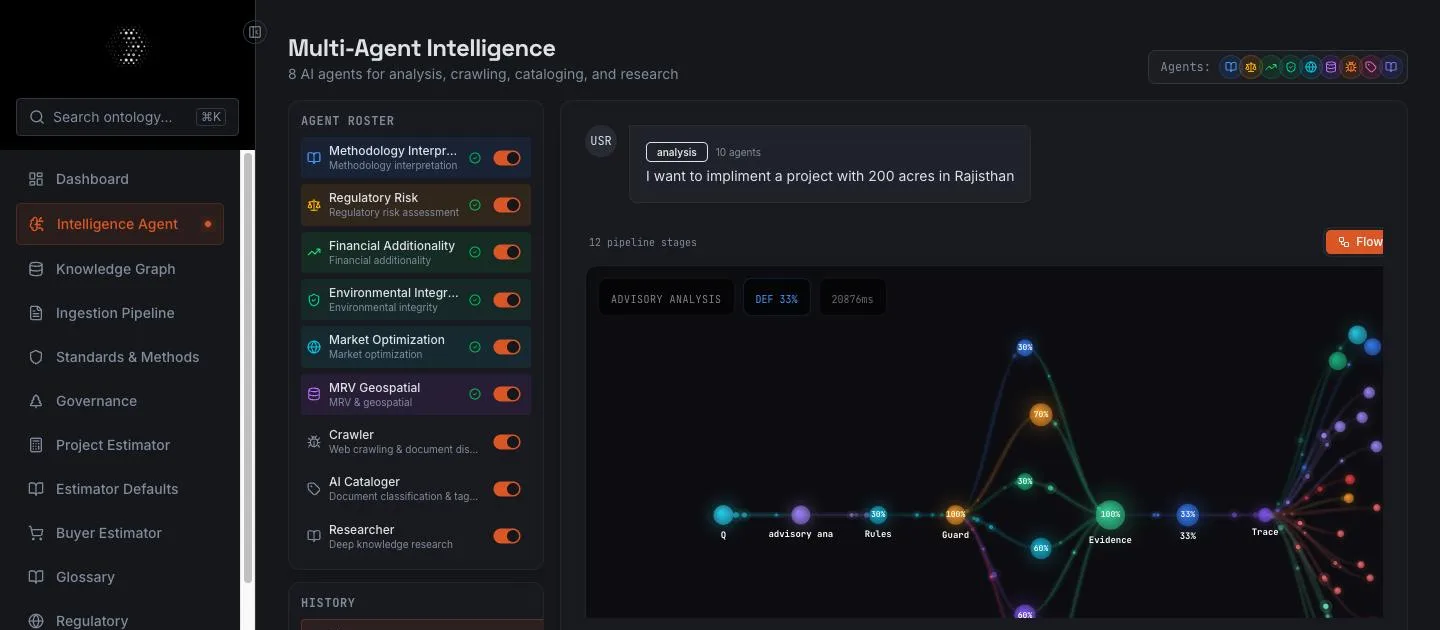
Guardrails before generation
An analysis passes through rules and guardrails before the agents see it. If a rule says ineligible, or critical data is missing, the agents never run. What they do say is matched to evidence, and unsupported statements are counted.
- Methodology, regulatory, financial and integrity agents
- Rule versions stored with each answer
- Pure calculations never call a model
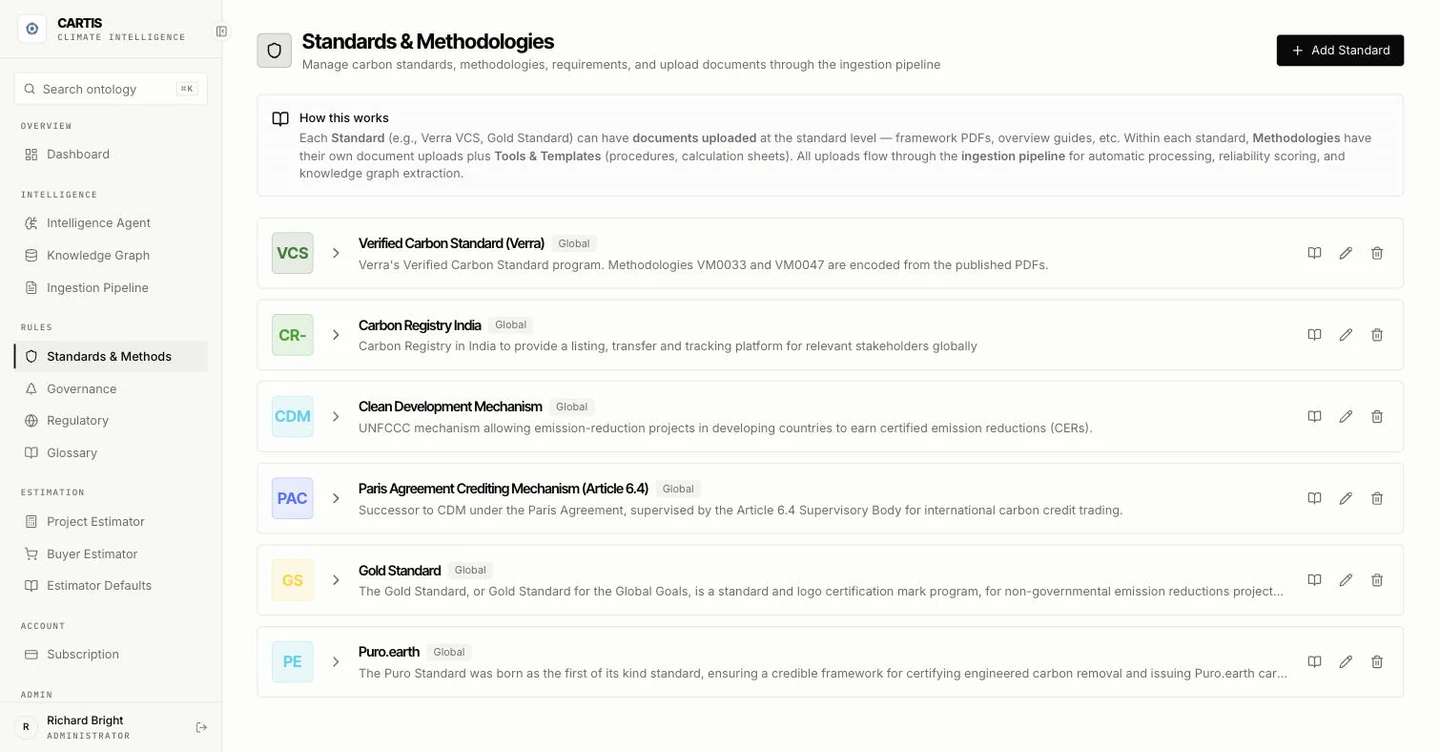
Standards
Every rulebook in one library
Carbon Registry–India, the CDM, the Paris Agreement Crediting Mechanism, Puro.earth and Gold Standard sit side by side, with their methodologies, tools and documents flowing through one ingestion pipeline.
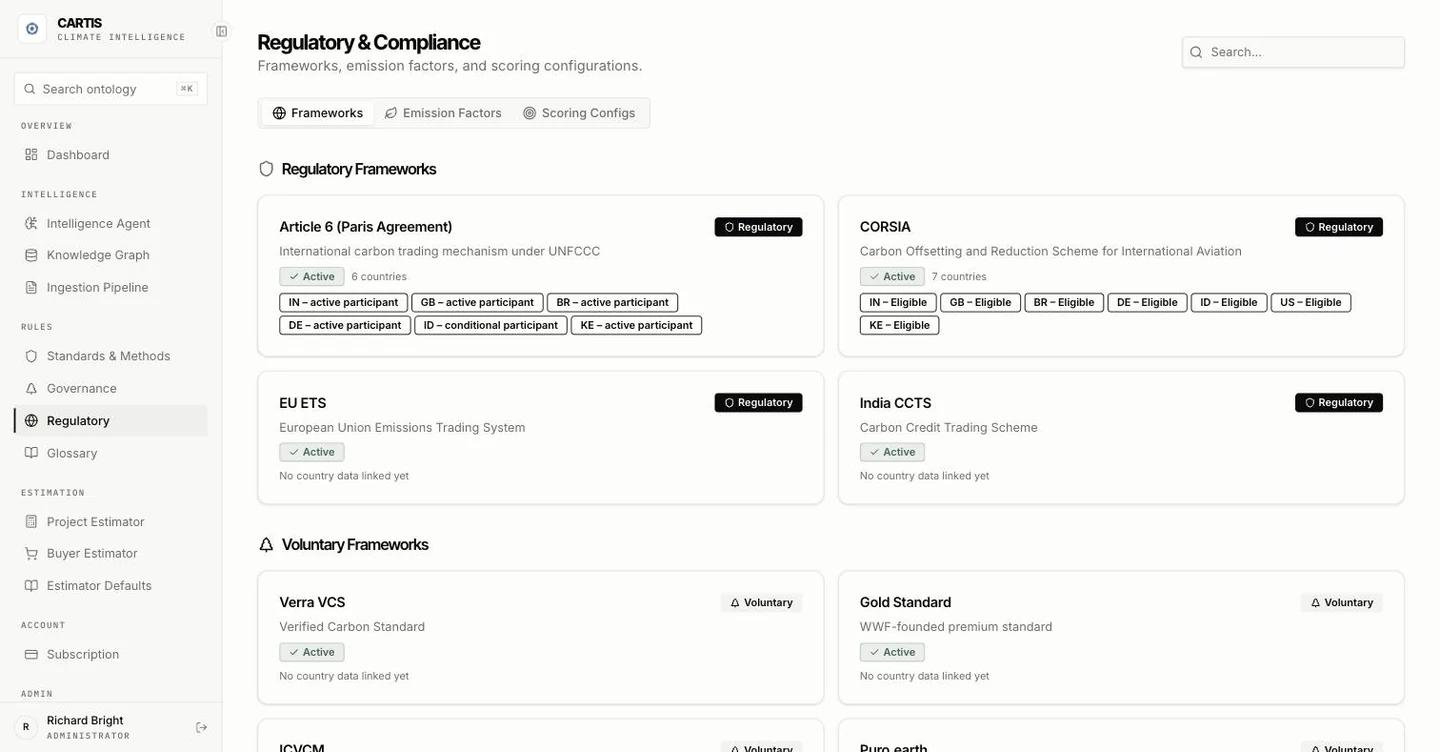
Regulatory
Frameworks, factors and country status
Article 6, CORSIA, the EU ETS and India’s CCTS are tracked with country participation, alongside emission factors and scoring configurations that keep their history.
How it works
An analysis, end to end
Capabilities
Everything in the box
Who it serves:
Project developers
Screen eligibility, estimate credits and plan projects.
Validation and verification bodies
See the same analysis and its trace.
Buyers
Value credits from the buyer's side.
Analysts
Build the corpus and encode the rules.
A governed corpus
Standards and methodologies stored with extracted text, a reliability score and a link to their source.
Rules, not prose
Eligibility rule trees and machine-evaluable baseline formulas for each active methodology, versioned on every change.
Deterministic before generative
No analysis reaches the agents if a rule says ineligible or critical data is missing. Pure calculations never call a model.
Six constrained agents
Agents reason over the rule engine's fixed output, and unsupported statements are counted.
A defensibility index
Each completed analysis stores its rule versions, evidence alignment and a graded defensibility score.
Credit and return estimator
Project and buyer-side estimates that show a coded diagnostic instead of a silent zero.
Principles
How it keeps its integrity
- Rules run before reasoning.
- Models draft, people activate.
- Every change has a version.
- Claims need evidence.
- Fail loudly: a formula that cannot be evaluated says so.
Clear scope
What it isn’t
- Not a rating agency
- It grades the defensibility of its own answers, not projects or credits for sale.
- Not a registry
- Issuance, transfer and retirement belong to AMMONIS.
- Not legal advice
- It reports what the encoded rules say.
Built on
What CARTIS stands on
The platform underneath, and what the work depends on outside it.
The platform
-
One platform core
The same evidence architecture the rest of the suite runs on: identity, roles, attribution and the audit trail are not rebuilt per product.
-
A deterministic rule engine
Eligibility rule trees and machine-evaluable baseline formulas run before any agent does.
-
An ontology over the corpus
Standards and methodologies are held as linked, versioned rules rather than as documents to search.
-
Constrained agents
Agents reason over the rule engine's fixed output, and every answer records the rule versions and evidence behind it.
The rules it holds
Registries and programmes
- CDM
- Paris Agreement (PACM)
- India CCTS
- Carbon Registry–India
- Verra
- Gold Standard
- Global Carbon Council
- Puro.earth
- Rainbow
International standards
- ISO 14000 series
- GHG Protocol
- ICVCM
- CORSIA
- CRCF
- ICROA
- FSC
- PEFC
Emission factors
- IPCC
- DEFRA
- National grid factors
- Published allometry
Reporting and compliance
- BRSR
- SBTi
- CDP
Representative, not the whole corpus.
Questions
Asked often
How is this different from a chatbot?+
A chatbot cannot tell you which version of which rule it relied on. CARTIS runs encoded rules first and stores the versions, the evidence and a defensibility grade with every answer.
Does it rate credits?+
No. It grades the defensibility of its own answers. It does not rate projects or credits for sale.
Which rulebooks does it cover?+
The CDM, the Article 6.4 mechanism, Verra, Gold Standard, ICVCM and India’s CCTS, each versioned as they change.
Is it legal advice?+
No. It reports what the encoded rules say.
Works with
Part of MARIS
Each product reads the climate from its own angle. With Climate Intelligence at the centre, together they cover it end to end.
Methodology rules and monitoring parameters go to SONDIS.
Explore →Methodology intelligence in both directions.
Explore →Pricing and ratings context in both directions.
Explore →Carbon project design from the first screening to the registration package, with every figure traced back to the rule it came from.
Explore →ESG compliance for Indian listed companies: one BRSR record per year, reviewed and reusable.
Explore →Investor onboarding and capital calls for Indian AIFs, with the fund register as the system of record.
Explore →